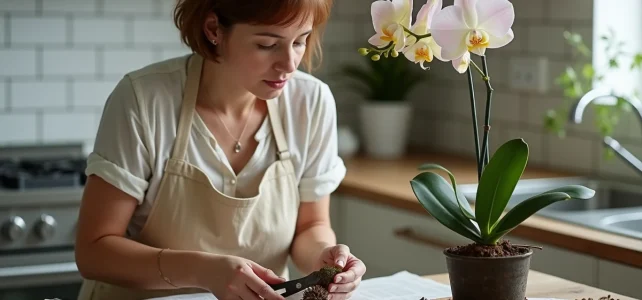
Your orchid has lost all its flowers, its leaves are yellowing, and its roots are turning brown. Before you throw it away, check one simple point: is the base of the stem, where the leaves emerge, still firm and green? If so, the plant is alive. Even if it’s very weakened, an orchid can bounce back if you provide the right care at the right time.
Soft and brown roots: the real diagnosis before taking action
Most guides start with watering or repotting. However, the first reflex should be to take the plant out of its pot to examine its roots. This is where everything is determined.
Healthy roots are firm, green (when moist) or silvery (when dry). Brown and spongy roots are dead and should be cut off. Use disinfected pruning shears and trim back to healthy tissue, even if only two or three viable roots remain.
Also check the collar, the area between the roots and the leaves. If it is black and soft, the plant is truly dead. If it remains green and firm, it is worth trying to revive it.
To understand how to revive a dead orchid, this root diagnosis is the prerequisite for any other intervention.
Reanimation in a humid environment: the “sphag and bag” method for rootless orchids
Have you removed almost all the roots and only one or two remain? Classic repotting in bark will not be enough. The plant no longer has enough anchors to absorb water in an airy substrate.
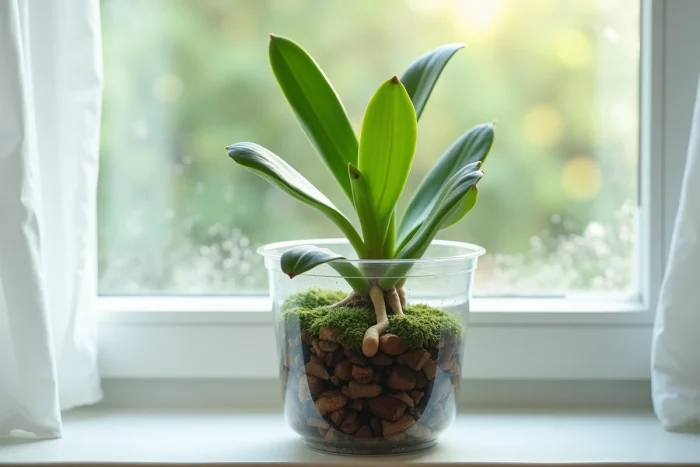
The so-called “sphag and bag” technique, popular among English-speaking orchid enthusiasts, involves placing the orchid on a bed of slightly moist sphagnum moss, then enclosing it in a transparent container (plastic box or partially open zip bag). The goal is to maintain high humidity without the roots sitting in water.
The principle is simple. The orchid, deprived of functional roots, cannot drink normally. However, it can absorb ambient moisture through its tissues. The closed container creates a miniature greenhouse effect that stimulates the production of new roots.
- Place a layer of wrung-out sphagnum (moist but not soggy) at the bottom of the container.
- Place the orchid on top without burying it; the collar should remain dry.
- Ventilate the container at least once a day to prevent mold.
- Wait for the appearance of new green roots before repotting, which can take several weeks.
This approach is rarely mentioned in mainstream French-language guides, which often stop at repotting in bark and soaking. However, it can make a significant difference for very weakened orchids.
Watering with lukewarm water and dry substrate: correcting the two most common mistakes
You may have come across the viral advice to water orchids with ice cubes. Smithsonian Gardens warns against this practice: cold water can cause damage to tropical roots. Phalaenopsis orchids, the most common indoors, originate from warm forests. Water at room temperature or slightly warm is much more suitable.
The other common mistake concerns the frequency of watering. Many people water on a fixed schedule (once a week, for example). The Royal Horticultural Society and Kew Gardens recommend instead to rely on the weight of the pot and the condition of the substrate. When the pot is light and the substrate feels dry to the touch, it is time to water. If the substrate is still moist, wait.
In practice, watering by soaking (immersing the pot for ten minutes in lukewarm water, then draining) remains the most reliable method. Drainage must be complete: an orchid that sits in stagnant water will develop root rot within a few days.
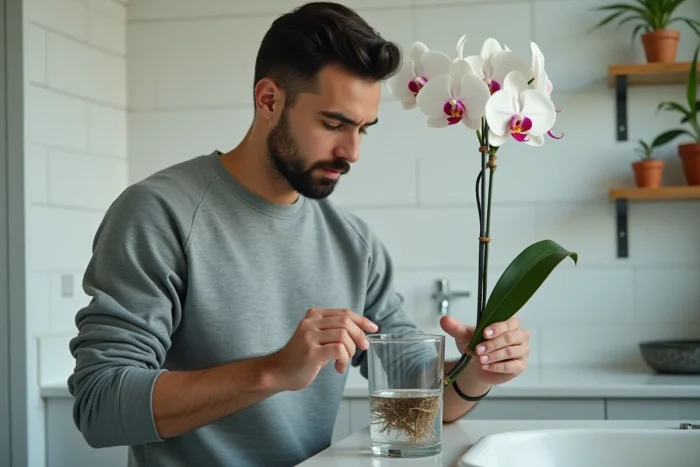
Nighttime temperature drop: the little-known trigger for reblooming
Your orchid has regained strength, its leaves are green and firm, new roots are growing, but nothing is happening on the flowering side. This is normal. The plant needs a signal to trigger a new flower spike.
This signal is a temperature difference between day and night of about 5 to 10 degrees. In their natural habitat, Phalaenopsis experience this variation daily. In an apartment, the temperature often remains stable, keeping the plant in a vegetative phase.
How to reproduce this difference? In the fall, place the orchid near an unheated window at night, ensuring that the temperature does not drop below 15 degrees. A few weeks of this regimen is often enough to trigger the appearance of a spike.
- Daytime: usual room temperature, between 20 and 25 degrees.
- Night: ideally between 15 and 18 degrees for two to four weeks.
- Light: bright but indirect, never direct sunlight that burns the leaves.
This action is documented by several horticultural institutions, but it is rarely explained in common advice articles. It is, however, the most determining factor for achieving a new bloom.
An orchid that seems dead almost always deserves a second chance. The diagnosis of the roots determines whether a plant can be saved or is lost. If the collar is healthy, reanimation in a humid environment restarts root production, appropriate watering stabilizes the plant, and the nighttime temperature drop eventually triggers blooming. The process takes time, sometimes several months, but a well-revived orchid can bloom for years.