
Thousands of sketchbooks accumulate in the drawers, bags, and shelves of amateur or aspiring illustrators. These pages scrawled in cafes, during commutes, or while traveling often contain much more than a style exercise: graphic universes, recurring characters, color and composition choices.
The line between this personal sketchbook and a professional illustration project is less clear than one might think, but crossing it requires a concrete change in method.
The sketchbook as an exploitable visual database
Reducing the sketchbook to a graphic diary means missing out on its professional potential. Workflows documented by illustration studios recommend treating the sketchbook as a strategic sketch reservoir rather than just a training space. The principle: derive several mini-compositions from the same subject, combine separately sketched elements (objects, characters, symbols) into new proposals, and then only push one or two high-finish directions from this reservoir.
This approach transforms each page into reusable raw material. A character sketched six months earlier can respond to a brief received the following week. A plant motif doodled during a walk can inspire a packaging proposal. Those looking to transition from personal sketchbooks to professional illustration projects benefit from organizing their sketchbooks by themes or types of elements rather than chronologically.
Sorting remains the thankless part of the process. Flipping through months of drawings to identify what has commercial potential requires a different perspective than the one that guided the initial stroke. It’s no longer about whether a drawing is “successful” but whether it can serve as a starting point for a coherent visual proposal for a client.
Client brief and free drawing: two creative logics to articulate
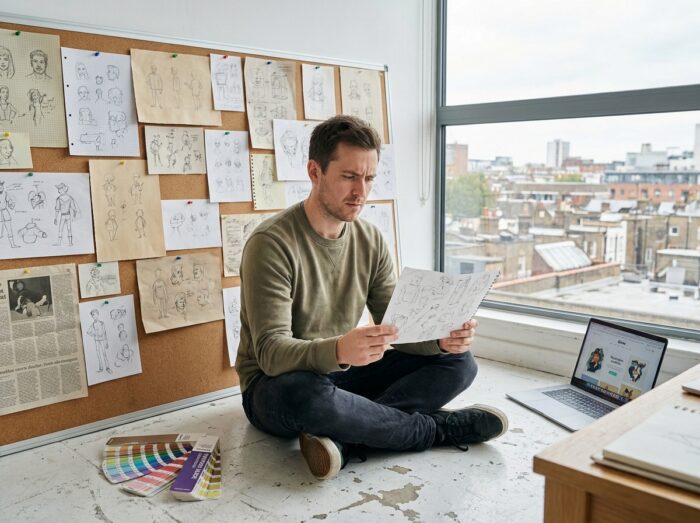
The transition to professionalism is not just about drawing better. It involves working under constraints, which profoundly changes the relationship to drawing. A creative brief imposes a subject, a format, a target audience, and sometimes a color palette. The sketchbook, on the other hand, imposes nothing.
Articulating these two logics requires developing a skill that free drawing does not cultivate: reading and interpreting a brief. Professional sources describe a process in precise steps:
- First reading of the brief to identify technical constraints (format, resolution, distribution medium) and the client’s expectations regarding the visual tone.
- Visual research phase where the sketchbook serves directly: it provides references, and quick directions are tested before proposing anything.
- Selection of two or three graphic directions to present, each derived from existing or new sketches, but always justified in relation to the brief.
The frequent temptation is to propose what one enjoys drawing rather than what the brief requests. The personal sketchbook can become a trap if it confines the illustrator to a single style. Artists who diversify their sketch subjects (architecture, plants, portraits, typography) mechanically broaden the spectrum of briefs they can respond to.
Billing for sketch work: an underestimated issue for beginner illustrators
A rarely discussed point in content aimed at budding illustrators concerns the economic value of the sketch phase. In professional practice, the work of research and visual proposal has a distinct value from the finishing. Documented pricing recommendations suggest clearly separating three items in a quote:
- Sketch fees (sometimes called “sketch fee”), which compensate for the time spent on research and proposal, often directly derived from sketchbook work. These fees are generally non-refundable.
- The finishing work (inking, coloring, adapting to the final format), billed separately.
- Usage rights, which depend on the distribution medium, duration of use, and covered territory.
Tying payment deadlines to specific milestones (concept approval, final sketch validation, delivery of the finished illustration) protects both the illustrator and the client. This breakdown acknowledges that the visual idea born in the sketchbook has its own market value, independent of the time spent refining it.
Building an illustrator portfolio from sketchbooks
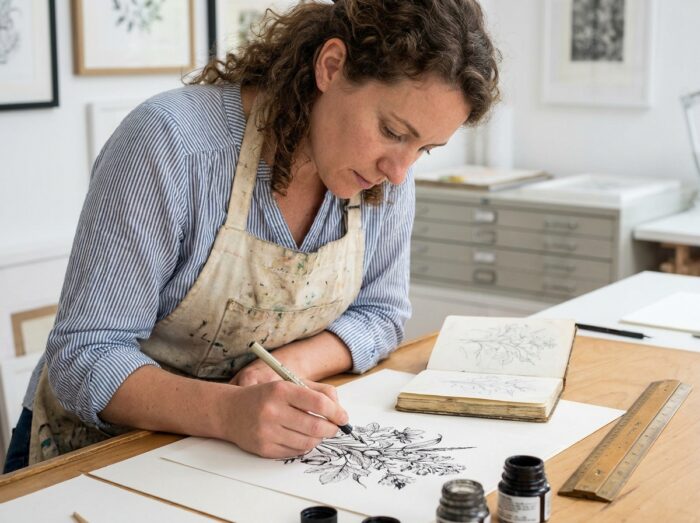
The portfolio remains the key to securing commissions. The question for sketchbook artists is what to show and in what form. Publishing raw scans of sketch pages does not have the same effect as a curated selection.
An effective approach is to show the journey of an illustration, from the initial sketch to the finalized version. This type of presentation demonstrates a capacity for mastered creative process, not just an isolated result. Clients, particularly in publishing and communication, seek illustrators who can document their process and justify their graphic choices.
What the portfolio must prove
Beyond the quality of the line, a portfolio built from sketchbooks must show three things: the regularity of practice, the diversity of subjects addressed, and the ability to transition from a spontaneous sketch to a usable finalized image. A sketchbook filled sporadically with identical subjects sends a limited signal. A dense, varied sketchbook, with some pages leading to completed projects, tells a very different story.
The selection remains crucial. It is better to present eight strong illustrations, each accompanied by its preparatory sketches, than forty pages of sketches without a clear direction. Sorting requires distance from one’s own work, an editorial skill that the practice of drawing alone does not always develop.
The sketchbook is not an obstacle to professional illustration work. It forms the foundation, provided it is treated as a production tool rather than just a recreational space. The difference between a sketchbook artist and a professional illustrator lies less in the level of drawing than in the ability to extract, organize, and enhance what lies between the pages.