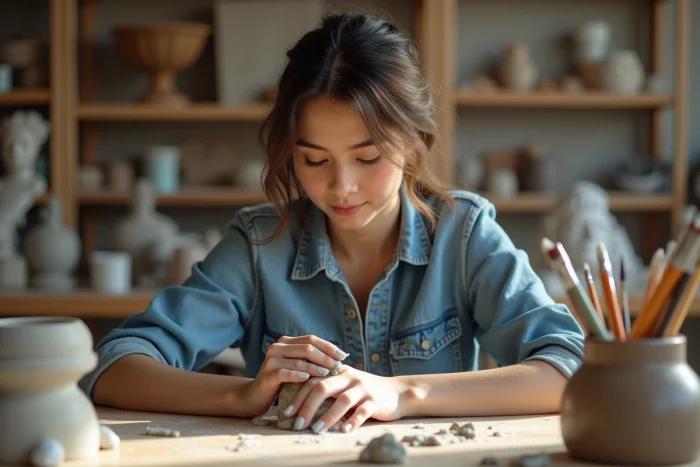
The official terminology strictly distinguishes between “plastic art” in the singular and the expression “plastic arts” in the plural, while common usage tends to confuse them. This lexical shift leads to misunderstandings, including in educational and institutional texts.
Some school programs, however, impose a precise classification, excluding certain disciplines from the category of “plastic arts” in favor of other nomenclatures. This distinction directly influences teaching practices and the structuring of artistic education.
Plastic art and plastic arts: why does this confusion persist?
This ambiguity between plastic art and plastic arts is not new. It can be explained by the evolution of usage, both among teachers and in cultural institutions. Singular or plural? The nuance, although crucial, often fades in conversation. In the singular, we talk about a process, a specific work, a unique gesture. In the plural, a constellation of disciplines emerges. But in reality, the boundaries intertwine.
At school, “plastic arts” refers to a set of practices: painting, sculpture, drawing, photography, printmaking, installation, performance, digital art. Almost everything is included. Behind this banner, the uniqueness of the plastic work sometimes fades, even though it embodies a personal expression, a freedom of exploration, without any utilitarian purpose.
This overlap is also explained by the coexistence of other artistic families, such as applied arts or visual arts. Applied arts are linked to professions, graphic design, architecture, fashion, furniture, advertising, illustration. Here, the objective is clear: to respond to a commission, a function, a use. The designer adapts to a set of specifications, while the artist in plastic arts explores, questions, and invents without a safety net.
To clarify, here are the points that distinguish each universe:
- Plastic arts: pure creativity, experimentation without utilitarian purpose, expression of emotions and a unique perspective.
- Applied arts: design for use, practical innovation, adherence to constraints and specific commissions.
The difference between plastic art and plastic arts thus largely depends on the intention guiding the creation and the relationship with the material. For those wishing to explore this boundary, the page “Difference between art and plastic art: detailed explanations – Studavenir” provides additional insights. This porosity, fluid yet structuring, influences how schools classify, teach, and help generations understand art.
Overview of plastic arts: disciplines, techniques, and inspiring examples
What stands out in plastic arts is their diversity and the emphasis on experimentation. Painting, sculpture, drawing, photography, printmaking: these are all fields of exploration where material becomes an extension of the imagination. Here, there are no utilitarian constraints. Each creation bears the mark of an intention, a feeling, a desire to share an emotion or sow doubt. Plastic art is the laboratory of individual expression.
From the frescoes of Lascaux to contemporary installations, this creative impulse transcends ages and is inscribed in the memory of civilizations. It is exhibited, transmitted, debated. In museums or on the street, in front of a canvas or a sculpture, nothing is fixed: the eye observes, the hand shapes, the mind questions. Plastic arts challenge, invite analysis, and open the door to questioning conventions.
To better grasp the richness of practices, here is an overview of the main disciplines and what they allow us to explore:
- Painting: infinite play with colors, textures, and supports, from traditional oil to contemporary acrylic.
- Sculpture: modeling, carving, or assembling, from wood to stone, metal to plastic, up to ephemeral installations.
- Photography and video: capturing reality, inventing a visual narrative, crossing still images with digital art.
- Performance and installation: mobilizing the body, occupying space, playing with time, and provoking direct encounters with the public.
The strength of these disciplines lies in their ability to convey a vision, to testify to an era, to make cultural heritage live differently. Each work has its story, its context, its choices. Artistic education, critique, and art history are all levers to give meaning to these practices and connect them to the collective adventure of creation.
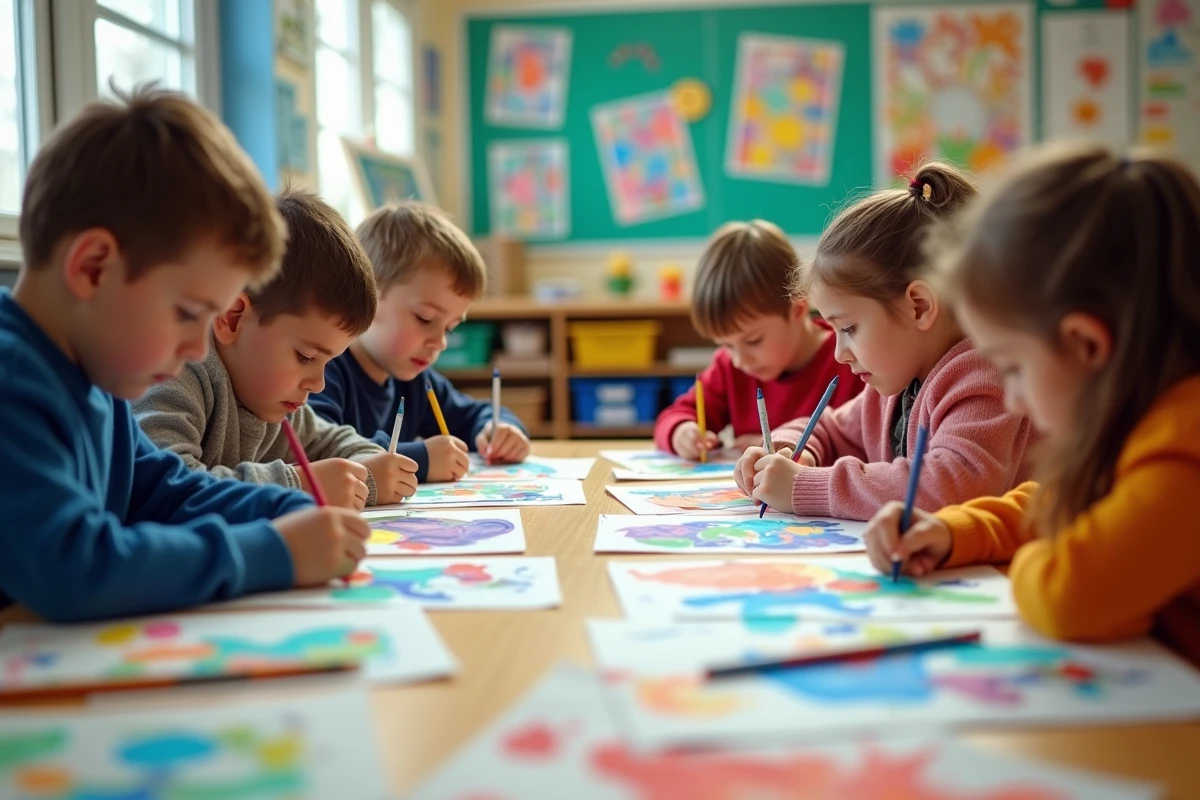
Fostering creativity in school: concrete ways to integrate plastic arts into teaching
The teaching of plastic arts goes beyond the simple acquisition of techniques. From childhood, it is a gateway to artistic awakening and the construction of a personal sensitivity. The creative gesture arises from experimentation, contact with various materials, and the discovery of major themes in creation. Here, the hand learns to translate the imaginary, the eye practices decoding, and analysis is built step by step.
By integrating creative practices into learning, schools offer a playground and a space for reflection. The workshop becomes a testing ground: one draws, paints, sculpts, photographs, and each activity nurtures critical thinking and encourages initiative. Nothing is fixed: the freedom of creation asserts itself, and the student learns to read images, to argue, and to defend their approach in front of others.
To strengthen the place of plastic arts in education, several levers can be mobilized:
- Establish regular workshops to multiply experiences and encourage practice.
- Develop interdisciplinary projects that intersect with science, history, or literature to enrich the meaning of creations.
- Encourage critical analysis of each production: debate, reflect collectively, and stimulate discussion around the work.
A solid education in plastic arts is based on art history but always looks to the future. It questions the present, guides the student towards autonomy, and affirms their own voice, far beyond mastering a simple skill. The result? A generation of free spirits, capable of viewing the world differently and leaving their mark on it.