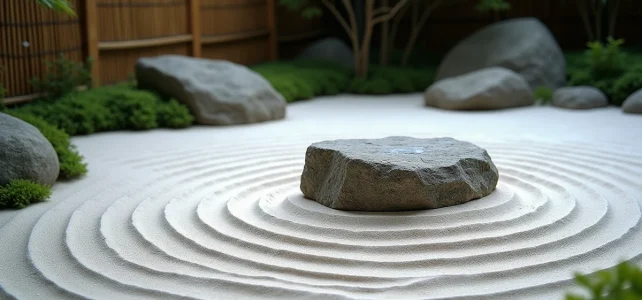
The term “sand” consistently appears in zen landscaping guides, but it conceals a more nuanced technical reality. Japanese karesansui, these dry gardens where minerals replace water, rely on a material whose grain size, color, and geological composition condition both the visual outcome and the durability of the installation. Understanding what distinguishes fine gravel from decorative sand, and why this distinction changes everything, helps avoid costly mistakes right from the purchasing phase.
Fine gravel or sand: a technical confusion that changes the result with a rake
In Japan, contemporary gardens predominantly use a very fine gravel with a grain size close to 2 to 4 mm rather than sand in the strict sense. This nuance, rarely explained in mainstream content, has direct consequences on daily use.
Sand that is too fine (less than 1 mm) compacts poorly outdoors. It disperses at the slightest gust of wind, forms dust in dry weather, and washes away during heavy rains. Fine gravel, on the other hand, offers significantly better stability: the grains stay in place, the grooves made by the rake retain their sharpness longer, and the natural drainage limits water stagnation.
To know which sand for a Japanese garden corresponds to your project, you must think in terms of grain size before considering color. Gravel of 2 to 4 mm rakes cleanly, does not stick to shoes, and withstands the elements without turning into mud.
Field reports vary on this point: some enthusiasts prefer finer sand for miniature indoor zen gardens, where wind and rain are not an issue. The choice thus directly depends on the location, whether indoors or outdoors, and the surface in question.
Color of sand for Japanese garden: pure white is not the traditional reference
The mental image of the zen garden often associates with an expanse of immaculate white. However, landscapers note a recent trend to move away from very bright white sand, deemed artificial and too close to a spa decor.
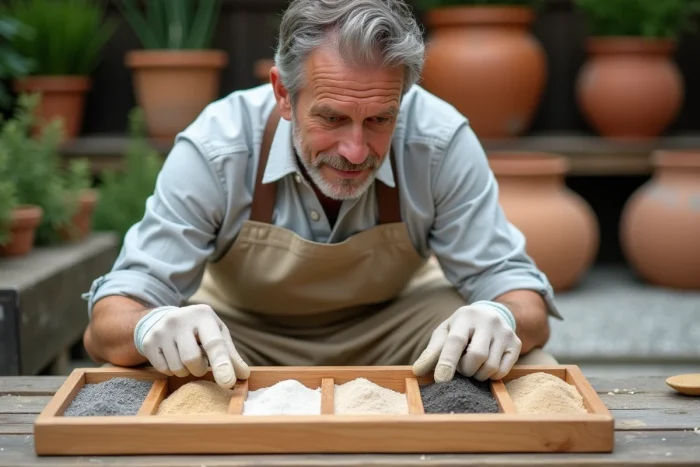
Historical karesansui, like those observed in the temples of Kyoto, use more subdued shades. Light gray, stone beige, or off-white dominate. These tones symbolize water while remaining tolerant of dirt (fallen leaves, dust, soil brought by the wind).
Three shades to consider depending on the context
- Natural light gray easily integrates into an existing garden with dark stones or moss. It ages well and does not yellow.
- Stone beige recalls the tones of crushed gravels used in Mediterranean dry gardens, making it coherent in the southern regions of France where the light is bright.
- Off-white remains the brightest without the artificial effect of pure white. It works well in shaded areas where natural brightness is low.
Pure white retains its relevance for miniature indoor zen gardens, where the absence of weather and plant debris preserves its clarity. Outdoors, light gray or beige gravel requires much less maintenance than bright white sand, which reveals the slightest fallen leaf.
Drainage constraints and stormwater management outdoors
The choice of material is not limited to aesthetics. In Europe, mineral gardens are increasingly subject to constraints related to stormwater management. Runoff to neighboring properties, water stagnation, and slipperiness on wet ground are points to anticipate.
Angular gravel (crushed) drains better than rolled sand. The irregular grains create interstitial spaces that allow water to pass through to the soil below. Very fine sand, on the contrary, can form an impermeable crust on the surface after a few rain episodes, worsening runoff.
Soil preparation under the gravel
Placing a geotextile fabric under the gravel layer prevents soil and weeds from rising without blocking drainage. This often-overlooked step conditions the longevity of the garden. Without geotextile, the soil eventually mixes with the gravel over a few seasons, altering the color and making raking difficult.
The thickness of the gravel layer must be sufficient for the rake to create clean grooves without touching the fabric. If too thin, the layer deforms and reveals the soil. Available data do not allow for a universal thickness, as it depends on the chosen grain size and the depth of the desired patterns.
Mineral composition and origin of gravel: granite, marble, or limestone
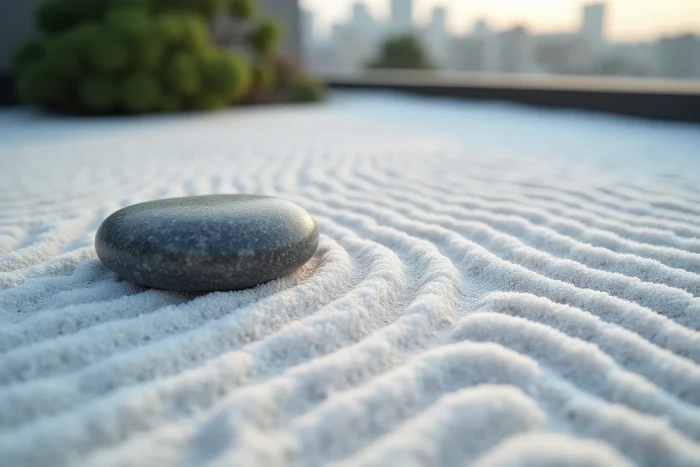
The geological nature of the gravel influences its longevity. Crushed granite withstands frost well and does not discolor, making it a solid choice for regions with harsh winters. White marble, being softer, can yellow over time when in contact with calcareous water or tannins from fallen leaves.
Crushed limestone offers a good balance between cost and aesthetics, but it fragments more easily under the effects of repeated freeze-thaw cycles. In regions where temperatures regularly drop below zero, this phenomenon produces fine white dust that alters the texture of the garden over the years.
- Granite: frost-resistant, stable color, angular grain favorable for drainage and maintaining grooves.
- Marble: very bright, suitable for indoor gardens or mild climates, but sensitive to yellowing outdoors.
- Limestone: economical, varied shades (cream, ochre, gray), but limited durability in continental climates.
The choice between these stones depends as much on the local climate as on the desired effect. An outdoor zen garden in northern France does not have the same constraints as a layout in Provence.
The authenticity of a Japanese garden does not rely on a unique material or an imposed color. It rests on the coherence between grain size, shade, climate, and intended use. A well-chosen fine gravel, laid on properly prepared soil, will yield a result more faithful to traditional karesansui than decorative sand purchased solely based on its appearance in a bag.