80% of secondary school teachers in France integrate at least one digital platform into their lessons each week. Behind this statistic lies a nuanced reality: the growing presence of digital tools in middle schools, accompanied by sometimes heated discussions about their real influence on learning and the risks of distraction and dependency.
Some middle schools opt for strict restrictions, while others bet on innovation to stimulate student autonomy and engagement. This wide gap illustrates how the best use of digital technology in the classroom remains an open question, with no universal answer.
Connected Schools: How Digital Technology Transforms the Learning Experience for All
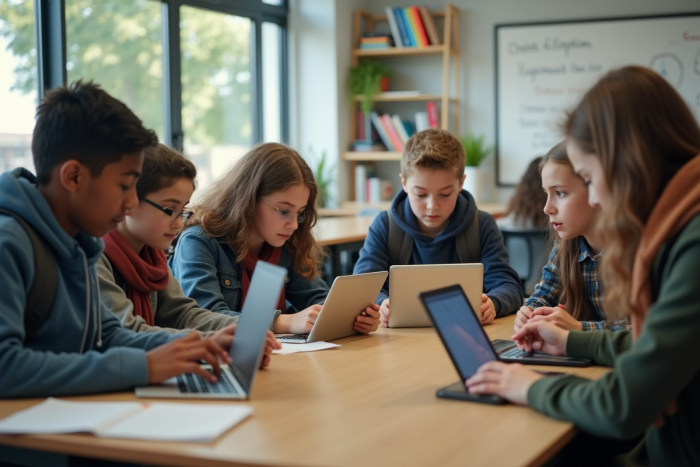
Connected schools mark a decisive step in the way we learn today. With tablets in hand, students build their knowledge, explore a variety of digital resources, and develop digital skills that far exceed the confines of the classroom. School days are now extended: interactive exercises, personalized content, collaborative workspaces. The teacher today orchestrates this dynamic environment where every student, including those with specific needs, receives tailored support.
The rise of digital platforms establishes new habits in daily school life. The digital workspace has become a mandatory stop for everyone. Take the example of Hauts-de-Seine: the ENC 92 platform simplifies exchanges, allows for online homework submissions, provides personalized feedback, and enables tracking of each student’s progress almost in real-time. This organization strengthens educational continuity and allows for adjustments to be made according to each individual’s pace.
Here’s how these digital tools are concretely changing the game in middle schools:
- Quick access to regularly updated educational resources
- Document sharing and remote corrections, promoting responsiveness
- Use of artificial intelligence to tailor content to individual needs
Educational technology is not just a matter of technology. It disrupts the relationship with knowledge, questions pedagogical habits, and requires teachers to continuously upskill. Successfully navigating this transition demands real dialogue among all stakeholders, reliable tools, and constant attention to ensure that access to education is not reserved for a few but open to all.

Parents, Teachers, Students: Achieving a Reasoned and Responsible Use of Digital Tools in Middle Schools
For a balanced use of digital tools, the vigilance of the entire educational community remains paramount. Parents, teachers, and students all have a role to play in establishing responsible habits. Teachers raise awareness among young people about media and information literacy, ask questions about usage, and establish clear guidelines. Families, in turn, observe practices at home, discuss needs, and encourage critical distance from screens.
In classrooms, the variety of digital resources stimulates motivation, sparks curiosity, but also requires attention to personal data protection. Awareness of confidentiality and respect for privacy has now become an integral part of the educational mission. To ensure that all students can progress, schools offer tailored solutions: applications to facilitate reading, differentiation software, accessible platforms—nothing is left to chance.
Among the practices that are gradually being adopted, we find:
- Support for the reasonable use of screens to avoid excess
- Strengthening the initial training of teachers to keep them up to date
- Regular dialogue between families and teaching teams to adjust practices
Integrating digital technology into middle schools means accepting to move forward continuously, rethinking methods, adjusting to evolving needs, and ensuring the inclusion of all, especially students with disabilities. Digital tools, far from being mere accessories, become powerful levers for a more open school that is attentive to every profile. The challenge? Ensuring that every child, regardless of their background, finds their place and progresses without hindrance on the path of connected learning.